

PSA Grading Australia – How to Grade Pokémon & Sports Cards
Official listing: Urban Empire Collectables appears on the PSA dealers search directory. Visit us at Unit 4/2 Templar Place, Bennetts Green NSW 2290 · (02) 4049 2264 · info@urbanempirecollectables.com.
PSA Grading Australia – The Complete Guide to Grading Pokémon & Sports Cards
If you've ever wondered whether you should grade a Pokémon card, sports card or trading card, you're not alone.
Every day collectors ask questions like:
- Is this card worth grading?
- Will PSA increase the value?
- Could this card get a PSA 10?
- Which grading company should I use?
- Is grading even worth it?
The truth is that grading isn't always the right decision.
Sometimes grading can significantly increase a card's value. Other times it can cost more than the value it adds.
That's why this guide isn't just about sending cards away, it's about helping you make the right decision before spending a dollar.
Whether you collect Pokémon, NBA, NFL, MLB, Formula 1, One Piece, Magic: The Gathering or another trading card game, the principles are the same.
We'll explain exactly how grading works, how to identify cards worth grading, what PSA looks for, and why some cards become worth thousands more after receiving a Gem Mint 10.
What is PSA?
Professional Sports Authenticator (PSA) is the world's largest and most recognised trading card grading company.
Founded in 1991, PSA authenticates, grades and encapsulates trading cards in tamper-evident holders designed to protect the card while giving buyers confidence in its authenticity and condition.
Today, PSA grades everything from:
- Pokémon
- NBA
- NFL
- MLB
- Soccer
- Formula One
- Magic: The Gathering
- One Piece
- Yu-Gi-Oh!
- Disney Lorcana
- UFC
- Vintage cards
- Modern cards
For most collectors, PSA remains the benchmark grading company. PSA-graded cards are widely accepted by collectors, auction houses and dealers, making them among the easiest graded cards to buy and sell.
Should You Grade Your Card?
This is the biggest mistake new collectors make.
They pull a nice card...
Immediately think:
"I'm sending this to PSA."
Stop.
Before you even think about the condition of your card, you need to ask one question.
Is grading actually going to add value?
The easiest way to answer that is by looking at completed eBay sales, not current asking prices.
Search for your card and filter by Sold Items.
This shows what collectors are actually paying, rather than what sellers hope to receive.
Example
Imagine your card sells for:
Raw: $10
A PSA 10 sells for:
PSA 10: $60
Now consider the costs involved:
- Grading fee
- Shipping to PSA
- Return shipping
- Insurance
- Marketplace selling fees (if you plan to sell)
If those costs total around $50, you've added little or no financial value by grading the card. In some cases, you may actually lose money.
This is why checking recent sold prices should always be your first step.
But grading isn't always about money
Not every card needs to make financial sense.
Some cards are worth grading because they mean something to you.
Maybe it's:
- Your childhood Charizard.
- The first autograph you ever pulled.
- A card your parents bought you.
- A favourite player you've collected for years.
- A card you simply want to preserve.
Those cards don't need to justify the grading fee.
If grading protects a card that you'll treasure for decades, that's value too.
How to Choose Cards Worth Grading
Once you've confirmed that grading could make financial sense, the next step is deciding whether your specific card is a good grading candidate.
Ask yourself these five questions.
1. Is the card already valuable?
Higher-value cards generally benefit the most from professional grading.
Low-value modern cards often don't gain enough value to justify grading costs unless they achieve a Gem Mint 10 and have strong collector demand.
2. Does a PSA 10 command a premium?
Some cards double in value after grading.
Others barely move.
Always compare:
- Raw price
- PSA 9 price
- PSA 10 price
If the difference between raw and PSA 10 is only small, grading may not be worthwhile.
3. Can the card realistically achieve a PSA 10?
This is where many collectors become overly optimistic.
A card can come straight from a booster pack and still have:
- Off-centre printing
- Factory print lines
- Chipped edges
- Surface scratches
- Corner wear
- Roller marks
- Indentations
A pack-fresh card is not automatically a Gem Mint 10.
In the next section we'll show you exactly what to inspect before deciding to grade.
4. Is the card popular?
A PSA 10 of a highly sought-after player or Pokémon is usually easier to sell than a PSA 10 of a less popular subject.
Collector demand matters just as much as condition.
5. Would grading make the card easier to sell?
Sometimes grading doesn't just increase value—it increases buyer confidence.
Many collectors are willing to pay more for a professionally authenticated card because they know exactly what they're buying.
Even when the price difference isn't huge, a graded card may sell faster than a raw copy
Understanding the Grading Criteria
Every card submitted for garding is carefully assessed in four key areas:
- Centering
- Corners
- Edges
- Surface
These four criteria work together to determine your final grade.
Many collectors assume a pack-fresh card is automatically a PSA 10. Unfortunately, that's rarely the case.
Modern printing is incredibly good, but factory defects are still common. Cards can come straight from a booster pack with off-centre printing, rough edges, print lines or small surface imperfections that immediately reduce the final grade.
Learning how to identify these issues before submitting your cards can save you hundreds—if not thousands—of dollars in unnecessary grading fees.
1. Centering
What PSA Says
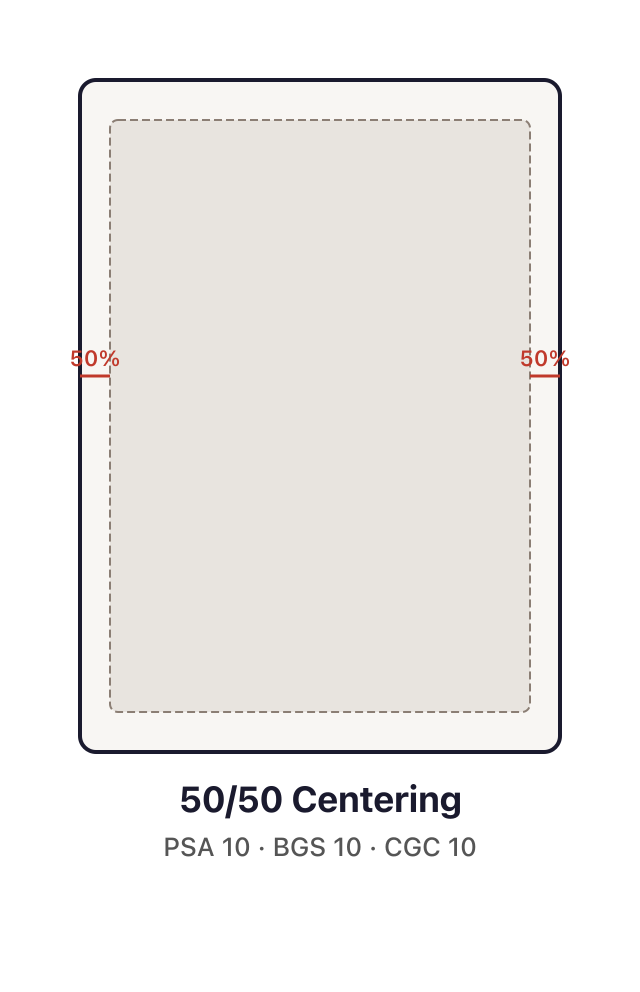
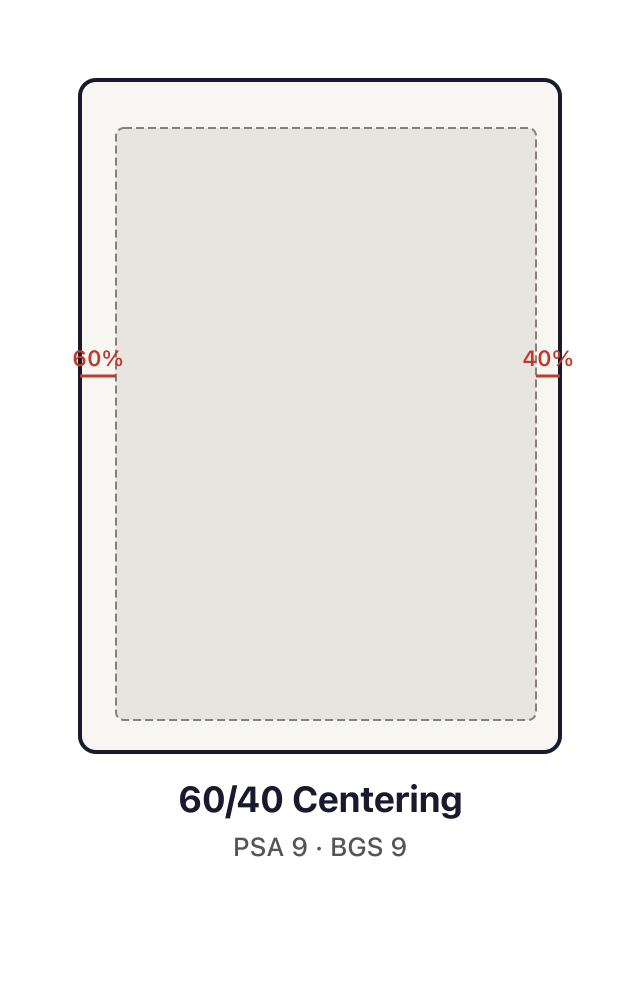
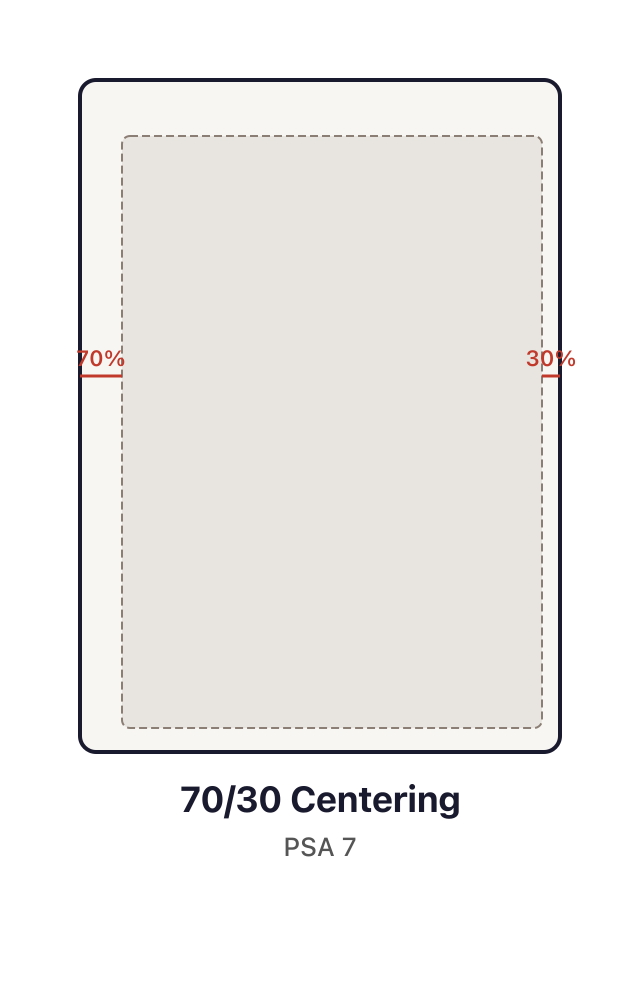
According to PSA's published grading standards, a Gem Mint 10 card should have front centering no worse than approximately 55/45, with rear centering no worse than approximately 75/25. Lower grades allow progressively greater centering variation.
What That Means
Centering refers to how evenly the image sits within the borders of the card.
Ideally, the borders should appear balanced from:
- Left to right
- Top to bottom
A card can have flawless corners, edges and surface, but if one border is obviously thicker than the opposite side, its grade may still be affected.
The front of the card is far more important than the back, but both should always be inspected.
How to Check It Yourself
Hold the card straight in front of you.
Ask yourself:
- Does one side immediately look thicker?
- Is the top border noticeably larger than the bottom?
- Does the back look significantly different?
If the card instantly looks off-centre without needing to measure it, there's a good chance PSA will notice too.
Urban Tip
Don't convince yourself it's "probably fine."
If you're unsure, compare it with another copy of the same card or use one of the many free centering tools available online.
2. Corners
What PSA Says
PSA describes Gem Mint cards as having four sharp corners, with only very minor manufacturing imperfections tolerated where they don't significantly affect the overall appearance of the card.
What That Means
Corners are usually one of the first things experienced collectors inspect.
Damage can include:
- White corner tips
- Soft corners
- Tiny bends
- Impact marks
- Fraying
- Factory corner dings
Even one damaged corner can stop a card from receiving a PSA 10.

The images above show slight whitening of a sports card on the left, and an example of bad corner on a Pokemon card
How to Check It Yourself
Inspect every corner individually.
Don't just glance over the card.
Use bright lighting and rotate the card slowly.
Many tiny flaws are almost invisible until the light catches them.
Urban Tip
Use your phone's torch at an angle.
Small chips and whitening become dramatically easier to see under direct light than under normal room lighting.
3. Edges
What PSA Says
For Gem Mint cards, PSA expects clean edges with no obvious wear. Small manufacturing imperfections may occasionally be acceptable, but visible chipping, whitening or damage will generally reduce the final grade.
What That Means
Edges are one of the most overlooked grading categories.
Collectors often spend all their time looking at corners while forgetting to inspect the entire edge of the card.
Common problems include:
- Edge whitening
- Chipping
- Rough factory cuts
- Colour loss
- Foil flaking
- Small nicks
Dark-bordered cards make these flaws much easier to spot.

Image above shows types of damage or issues to look
How to Check It Yourself
Rotate the card slowly.
Inspect every edge under bright light.
Pay particular attention to black-bordered Pokémon cards and chromium sports cards where tiny chips stand out immediately.
Urban Tip
Don't confuse factory rough cuts with handling damage.
Some products are notorious for leaving the factory with rough edges. Knowing which sets commonly suffer from these issues can help you decide whether grading is worthwhile.
4. Surface
What PSA Says
A Gem Mint surface should be clean and free from significant defects. PSA also considers the overall eye appeal of the card when determining the final grade.
What That Means
Surface is often the hardest grading category for beginners.
Many flaws are invisible until the card is viewed under strong lighting.
Common surface defects include:
- Print lines
- Hairline scratches
- Roller marks
- Indentations
- Pressure marks
- Fingerprints
- Factory debris
- Surface dimples
- Scuffing
- Wax stains (older cards)
One tiny indentation can easily stop an otherwise perfect-looking card from receiving a PSA 10.
How to Check It Yourself
Hold the card only by the edges.
Tilt it slowly under a bright light.
Rotate it through several different angles.
Don't just inspect the holographic area—check the entire card.
Many collectors only notice a surface defect after their graded card comes back as a PSA 9.
Very Fine surface scratched on a Pokemon card
Urban Tip
Never wipe a holographic card with your shirt, paper towel or tissue.
If you need to remove fingerprints or dust, use a clean microfiber cloth designed for delicate surfaces and handle the card with extreme care.
Factory Defects vs Damage
One of the biggest misconceptions in the hobby is that pack fresh means perfect.
It doesn't.
Cards regularly leave the factory with:
- Off-centre printing
- Print lines
- Roller marks
- Surface dimples
- Factory scratches
- Chipped edges
- Ink imperfections
Unfortunately, PSA grades the condition of the card—not the cause of the flaw.
A factory print line can reduce a grade just as much as a scratch caused after opening the pack.
That's why every card should be carefully inspected before deciding whether it's worth grading.
Can This Card Realistically Get a PSA 10?
Before submitting your card, work through this checklist.
✅ Have you checked recent eBay Sold prices to make sure grading makes financial sense?
✅ Does the card appear well centred?
✅ Are all four corners sharp and free from whitening?
✅ Are the edges clean with no chipping or wear?
✅ Have you inspected the surface under bright lighting from multiple angles?
✅ Have you looked for print lines, dents and pressure marks?
✅ Would you still feel confident sending this card if it belonged to someone else?
If you answered no to any of these questions, it doesn't necessarily mean you shouldn't grade the card—it simply means you should adjust your expectations.
Remember, a PSA 9 is still an outstanding grade and can add significant value to many cards.
Urban Empire's Grading Tip
One of the most common mistakes we see is collectors falling in love with their own cards.
It's natural—you've just pulled a huge hit or you've owned the card for years.
But emotion can cloud judgement.
If you're unsure, put the card away overnight and inspect it again the next day with fresh eyes.
Better still, ask another experienced collector for their opinion.
The best grading decisions are made objectively, not emotionally.
Which Grading Company Should You Choose?
One of the most common questions we hear is:
"Who should I grade with?"
The answer depends on why you're grading the card.
Are you looking to maximise resale value?
Protect a sentimental card?
Build a personal collection?
Or chase one of the rarest labels in the hobby?
Each grading company has its own strengths, but they are not viewed equally by the market.
PSA – The Industry Standard
For most collectors, PSA remains the benchmark.
There are several reasons why PSA continues to dominate the hobby:
- The world's most recognised grading company.
- Extremely liquid—buyers know exactly what they're purchasing.
- Strong demand across Pokémon, sports cards and TCGs.
- Widely accepted by auction houses and dealers.
- Generally achieves the strongest resale prices for Gem Mint examples.
If your goal is to maximise resale value or make your card easier to sell, PSA is often the safest choice.
That doesn't mean PSA is always the "best" grader—it simply means it remains the grading company most trusted by the market.
Beckett (BGS)
Beckett Grading Services (BGS) has been one of the hobby's most respected grading companies for decades.
Unlike PSA, Beckett traditionally provides subgrades, allowing collectors to see separate scores for:
- Centering
- Corners
- Edges
- Surface
Many collectors love this extra level of transparency.
The Black Label
If there is one grade capable of outperforming a PSA 10, it's the BGS Black Label 10.
To receive a Black Label, a card must achieve perfect 10 subgrades across all four grading categories.
Because these grades are exceptionally difficult to achieve, Black Labels often command some of the highest prices in the modern card market.
For the overwhelming majority of submissions, however, a PSA 10 will generally be easier to sell and often commands stronger prices than a standard BGS 9.5 or BGS 10.
CGC
CGC has built a strong reputation, particularly within Pokémon and Trading Card Games.
Collectors appreciate:
- Consistent grading.
- High-quality holders.
- Excellent presentation.
CGC has grown significantly over recent years and is a respected option for many collectors.
However, equivalent CGC grades will often sell for less than comparable PSA 10s simply because PSA remains the grading company most collectors actively seek.
That gap may vary depending on the card, rarity and current market conditions.
TAG
TAG is one of the newest companies making waves in the hobby.
Its biggest point of difference is the use of advanced technology and computer-assisted grading to improve grading consistency and transparency.
Many collectors also consider TAG slabs among the best-looking holders on the market.
TAG continues to gain popularity, and it's exciting to see innovation entering the grading space.
That said, PSA still has a significant advantage in terms of market acceptance and resale value.
TAG is a company worth watching over the coming years.
Lesser-Known Grading Companies
Every year, new grading companies enter the market.
While some offer attractive pricing or faster turnaround times, the reality is that most are not yet widely recognised by buyers.
If your primary goal is to maximise resale value, collectors generally place the greatest trust in established companies such as PSA, BGS and CGC.
A card graded by an unknown company may still be well protected, but it is less likely to achieve the same market value because buyers have less confidence in the grading standard.
Preparing Your Cards for Grading
Once you've decided a card is worth grading, proper preparation becomes critical.
A careless mistake before shipping can easily damage an otherwise high-grade card.
We recommend:
- Wash and dry your hands before handling cards.
- Hold cards only by the edges.
- Place the card into a penny sleeve.
- Insert the sleeved card into a Card Saver or approved semi-rigid holder.
- Avoid top loaders unless specifically requested.
- Never use tape directly on the holder.
- Package cards securely to prevent movement during shipping.
Taking a few extra minutes to package your cards properly can prevent damage that would permanently affect the final grade.
Common Mistakes Collectors Make
After handling thousands of cards, these are the mistakes we see most often.
Assuming Pack Fresh Means PSA 10
Factory defects are incredibly common.
Always inspect every card before submitting.
Looking at Asking Prices Instead of Sold Prices
Collectors often see a card listed for $500 and assume that's what it's worth.
Always use completed sales to determine real market value.
Ignoring Surface Defects
Surface flaws are one of the biggest reasons cards miss PSA 10.
Always inspect under strong lighting.
Grading Every Big Pull
Not every chase card should be graded.
Sometimes selling the card raw is the smarter financial decision.
Expecting Every Card to Gem
Even experienced collectors regularly receive PSA 9s.
A PSA 9 is still an outstanding grade.
Frequently Asked Questions
Is PSA grading worth it?
If grading significantly increases the value of your card—or helps protect a sentimental piece—then yes.
Always compare raw value against graded value before submitting.
Can I grade Pokémon cards?
Absolutely.
PSA grades Pokémon cards from every era, including English and Japanese releases.
Can I grade sports cards?
Yes.
PSA grades cards from all major sports, including NBA, NFL, MLB, AFL, NRL, Soccer, Formula 1, UFC and more.
Does PSA clean cards?
No.
Cards are graded in the condition they are received.
Attempting to clean or alter a card can lead to serious issues and may result in the card being rejected or receiving an altered designation.
How often should I submit?
Many collectors prefer to submit several cards together to reduce shipping costs.
Urban Empire Collectables offers regular group submissions, making the process simpler and more cost-effective for Australian collectors.
PSA Submissions Through Urban Empire Collectables
Sending cards directly overseas can feel intimidating, especially if it's your first submission.
At Urban Empire Collectables, we help take the stress out of the process by handling regular PSA group submissions for collectors across Australia.
When you submit through Urban Empire Collectables:
- Your cards are carefully checked before submission.
- We assist with paperwork and submission requirements.
- Cards are consolidated into group submissions where applicable.
- We manage international shipping to and from PSA.
- Your graded cards are safely returned for collection or shipping.
Whether you're grading your first Pokémon card or building a high-end investment portfolio, our goal is to make the process as simple and transparent as possible.
Next steps: check current PSA and Beckett grading prices, read how PSA submissions through Urban Empire work, and pick up card savers and grading supplies before you send. Already graded? Browse PSA-graded slabs in our Pokémon singles and NBA cards collections.
Final Thoughts
Grading isn't just about chasing PSA 10s.
It's about protecting your collection, making informed decisions and understanding what truly adds value.
Sometimes the smartest decision is to grade.
Sometimes the smartest decision is to leave a card raw.
Knowing the difference is what separates experienced collectors from everyone else.
We hope this guide has helped you understand not only how grading works, but when grading makes sense.
If you're still unsure whether a card is worth submitting, bring it into Urban Empire Collectables or get in touch. We'd much rather help you make the right decision than see you spend money grading a card that isn't likely to benefit.
Continue Your Grading Journey
Whether you're grading your very first Pokémon card or submitting a high-end sports card collection, we've got everything you need to help protect your cards and maximise their potential.
Explore More Trading Card Guides
Want to learn more? Check out our other collector resources:
- Pokémon Cards Australia – Learn about collecting Pokémon cards, the latest sets and products.
- MLB Trading Cards Australia – A complete guide to Topps Baseball and Major League Baseball cards.
- NBA Trading Cards Australia – Everything you need to know about collecting basketball cards.
- NFL Trading Cards Australia – Learn about Panini and Topps football releases.
- Soccer Trading Cards Australia – UEFA, Premier League, FIFA and more.
- Magic: The Gathering Australia – Products, formats and organised play.
- Topps Trading Cards Australia – Learn about Topps products, box formats and flagship releases.
- Topps Box Types Explained – Understand the differences between Hobby, Jumbo, Mega, Value, Blaster and Breaker's Delight boxes.
- Trading Card Supplies – Protect your collection with penny sleeves, Card Savers, toploaders, binders and storage solutions.
Ready to Submit Your Cards?
Urban Empire Collectables offers regular PSA group submissions for collectors across Australia. If you are dropping cards at our Bennetts Green store, read PSA Submission Newcastle — how it works first.
Whether you're submitting a single childhood favourite or an entire collection, we'll help guide you through the process and ensure your cards are prepared correctly before they're sent to PSA.
Learn more: How PSA submission works in Newcastle · Start a PSA grading order
Shop Our Trading Card Categories
Looking for your next grading candidate?
Browse our latest arrivals:
- Pokémon Singles
-
Pokémon Booster Boxes
- NBA Singles
- NFL Singles
- MLB Singles
- Soccer Singles
- One Piece Singles
- Magic: The Gathering Singles
-
UFC Singles
- New Arrivals from Topps
Prefer cards that are already graded? Browse our graded cards, slabbed by PSA, Beckett (BGS), CGC and SGC.